
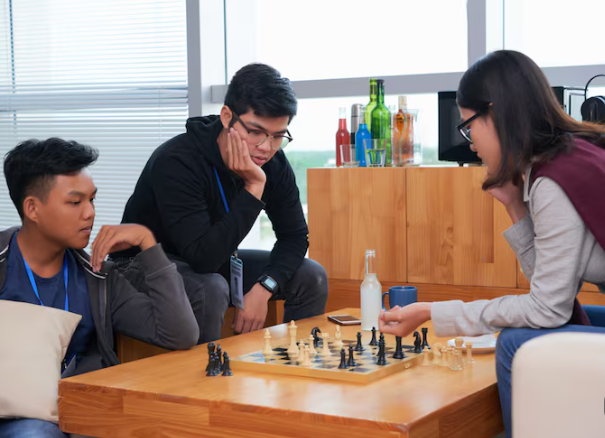
A strategy game can turn a simple question—“What should I do next?”—into a demanding mental exercise. Players must consider their goals, examine available options, and anticipate what might happen after each move. Whether the challenge involves a chessboard, a cooperative board game, or a digital simulation, progress often depends on making thoughtful choices under changing conditions.
These experiences provide opportunities to practice problem-solving and decision-making. However, becoming skilled at a game does not automatically produce equal improvements in school, work, or everyday life. The connection becomes more meaningful when players reflect on their choices and recognize where similar reasoning may be useful elsewhere.
Breaking Complicated Problems Into Smaller Parts
Strategy games often present several challenges at once. A player may need to defend a position, gather resources, and prepare for an opponent’s next move. Trying to solve everything immediately can lead to rushed decisions.
A more manageable approach is to separate the situation into smaller questions:
- What is the most urgent threat?
- Which resources are available?
- What needs to happen before the next objective becomes possible?
- Which action would improve the overall position?
For example, a player struggling to expand a settlement might initially focus on producing more buildings. A closer examination could reveal that the real obstacle is an unreliable supply route. Addressing that bottleneck may be more useful than increasing production.
This process encourages players to define a problem before choosing a solution.
Planning Beyond the Next Move
An action that looks attractive immediately may create difficulties later. Strategy games make these tradeoffs visible.
In chess, capturing a piece can expose a more valuable piece to attack. In a city-building game, spending heavily on expansion may leave too little for essential services. Players need to consider both immediate benefits and future consequences.
Planning involves imagining possible sequences: if one action is taken, how might the situation change, and what options would remain?
Good planning also requires flexibility. A detailed plan loses value when it depends on an opponent behaving exactly as expected. Players must identify assumptions and prepare alternatives.
The useful habit is to think ahead while remaining willing to revise the plan.
Making Decisions With Incomplete Information
Many strategy games reveal only part of the situation. Players may not know an opponent’s resources, hidden objectives, or next move.
This uncertainty encourages them to distinguish between what they know and what they suspect. A visible action provides evidence, but interpreting it still requires judgment.
A player might ask whether an opponent is preparing an attack or simply strengthening a defensive position. Committing everything to one interpretation could be costly, so gathering more information may become the best move.
These situations provide practice in making reasonable choices without complete certainty. They also show why confidence should match the strength of the available evidence.
Managing Limited Resources
Resources in strategy games can include money, time, materials, territory, or a limited number of actions. Because players cannot usually do everything at once, they must set priorities.
Choosing one option often means delaying another. Spending resources on defense may reduce the amount available for exploration. Pursuing an ambitious objective might leave fewer options for responding to surprises.
This introduces opportunity cost: the value of what is given up when making a choice.
Players learn to consider whether an action supports their main objective or merely feels productive. A large collection of resources, for instance, may accomplish little if those resources are never used effectively.
Managing resources well requires a balance between preparation, action, and flexibility.
Recognizing Patterns Without Relying on Them Blindly
Repeated play helps players recognize familiar situations. They may notice a vulnerable position, a developing shortage, or a sequence of moves that previously caused trouble.
Recognizing these patterns can make decisions faster. Instead of examining every possibility from the beginning, players can focus on the details most likely to matter.
However, familiar situations are rarely identical. A tactic that succeeded before may fail when the available resources, timing, or opponent changes.
Thoughtful players use past experience as a starting point and then check whether the present situation supports the same response. This combines efficient recognition with careful evaluation.
Learning From Feedback and Mistakes
Games provide feedback through their rules and outcomes. A weak defense may lead to lost territory, while a poorly timed investment may delay progress.
That feedback becomes more useful when players examine the reasoning behind the result. Losing does not necessarily mean every decision was poor, particularly in games involving chance. Similarly, winning can conceal mistakes.
A useful review asks:
- What information was available when I made the decision?
- Which assumption proved incorrect?
- Did I overlook a realistic alternative?
- What would I change in a similar situation?
This approach treats mistakes as evidence to examine. It encourages improvement without reducing every outcome to success or failure.
Practicing Decisions Under Different Time Limits
Turn-based and real-time games place different demands on players.
Turn-based games often allow time to compare alternatives and examine consequences. Real-time games require players to prioritize while events continue to unfold.
Both formats can create useful challenges, but speed alone is not the same as sound judgment. A quick choice may be appropriate for an urgent threat, while a major commitment may deserve more analysis.
Players can practice identifying which decisions need immediate attention and which can wait. This helps prevent minor distractions from consuming the attention needed for important choices.
Developing Communication Through Cooperative Play
Cooperative strategy games require players to solve problems together. Team members may have different information, responsibilities, and preferences.
Effective cooperation involves explaining a proposal clearly, listening to alternatives, and coordinating actions. A player may need to explain why saving a resource now would benefit the team later.
Disagreement can become productive when players compare their reasoning instead of competing to control every decision. Taking turns leading discussions also gives different participants room to contribute.
The quality of cooperation depends on how people play together. Respectful communication and shared participation matter as much as the game’s design.
Making the Learning More Deliberate
Players can make strategy gaming more reflective by setting a small goal for each session. That might mean checking assumptions before acting, preserving a backup option, or reviewing one important decision afterward.
A suitable challenge level matters too. Games that are overwhelmingly difficult may encourage guessing, while familiar challenges may require little new thought.
Connecting a game experience to a specific situation outside play can also be useful. For example, identifying a production bottleneck in a simulation may provide a way to think about a stalled group project. The comparison should account for the differences between game rules and real circumstances.
Strategy games offer structured opportunities to plan, test ideas, and respond to consequences. Their educational value grows when players pay attention to how they reach decisions, question their assumptions, and use feedback to improve their next attempt.
Read more: Understanding the Importance of Financial Planning at Different Life Stages